
Archibald Knox
The designer synonymous with the early Liberty name and still in demand today

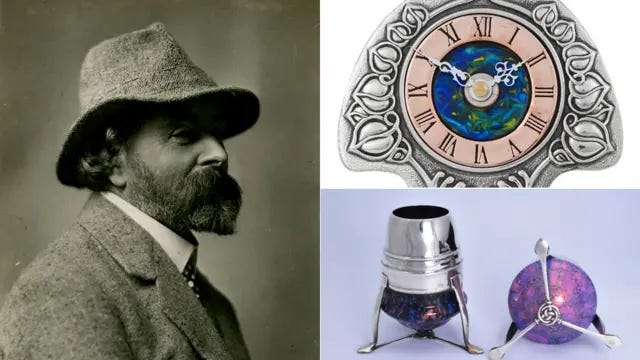
After writing about Liberty last week, I found myself in a rabbit hole researching more about the artist, synonymous with the store, Archibald Knox. I think I am becoming a super fan. So here is a short post about the artist and his works, with a few tips on places to see his work in public collections.

Early Life on the Isle of Man
Born on the Isle of Man to Scottish parents, Archibald Knox grew up influenced by the island’s Celtic crosses and rugged landscapes. Trained at Douglas School of Art, he immersed himself in Manx Celtic motifs, creating designs that interlaced patterns, knotwork, and nature forms that would later define his career. By his 20s, Knox was teaching design and working as a freelancer, blending Arts & Crafts ideals with emerging Art Nouveau.
Liberty: Tudric & Cymric (1899–1912)
Knox began designing for Liberty around 1899, introduced via the Silver Studio. Liberty kept designers anonymous (a policy that is said to have frustrated Knox), but his output was enormous: over 400 designs for their Cymric (silver/gold) and Tudric (pewter) ranges.
Tudric Pewter (launched 1902): Affordable “people’s silver” (or “poor man’s silver” as it was often termed) made by Birmingham’s W.H. Haseler. Knox’s designs featured minimalist forms with Celtic repoussé, abalone inlays, and organic motifs—jugs, trays, clocks, vases. Tudric democratised high design, with model numbers (often 4‑digits for Knox) stamped on bases.
Cymric Silver: More luxurious, with enamels, gems, and intricate chasing. Knox’s belt buckles, brooches, and inkstands bridged Celtic Revival and Modernism.
Liberty’s catalogues hailed Knox’s work as “breaking away from convention,” creating a distinctly British Art Nouveau. He even designed Arthur Liberty’s gravestone.


Later Career & Knox Guild (1912–1933)
Knox left Liberty in 1912 after clashing with teaching examiners at Kingston School of Art—his “unorthodox” Celtic methods led students to form the Knox Guild of Design and Crafts (1911–1939). He briefly designed carpets in Philadelphia before returning to the Isle of Man, where he died in 1933. His influence faded as his style went out of fashion, but revival began in the 1960s.
Museum Highlights & Collector Appeal
Today, you can find examples of his work in the following museums and elite private collections.
V&A Museum: Tudric teapot (c.1903, model 0409) and enamel brooches—showcasing his cane handles and “honesty” plant motifs.
British Museum: Cymric teapot with Celtic interlacing.
Manx Museum: Card trays and crumb trays from the Tudric range.
Cannon Hall Museum: Pair of Tudric vases (mid-1900s).
At auction, Tudric starts at £200–500 for smalls; choice Knox vases/clocks hit £2,000–10,000; Cymric rarities can exceed £20,000. Look for 4‑digit model numbers, enamel inlays, and sharp repoussé (line engraving). Note we also need to be aware of the many fakes on the market; Stephen Martin’s Archibald Knox (1995) is a great reference guide for his work.
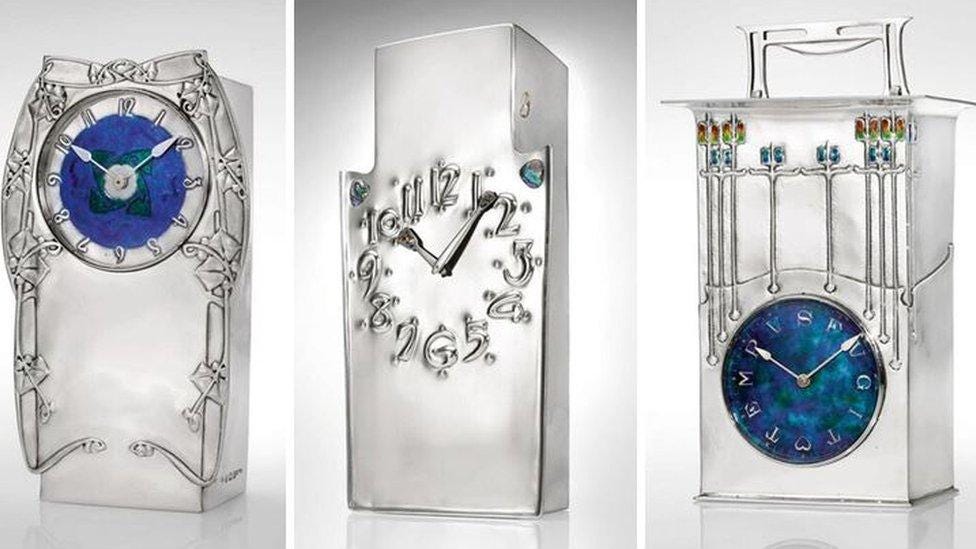
Collecting his work today
Lately, there has been renewed and increasing interest in his works. Knox bridges eras: Celtic heritage meets modernist restraint, perfect for “quiet luxury” interiors. Tudric’s pewter is accessible (for now) yet investment-grade. As Liberty fans know, Knox was a quiet force behind their metalware dominance - collect him to own a piece of that story.


Are you a fan of his work or Tudric? I recently sold a piece I loved and consider it ‘the one that got away’ so I won’t be making that mistake again soon. I’m on the hunt again!
Leah x